Topics
- Business Risk and Resilience
In an era of compounding risks, the organisations that navigate crises best are not merely prepared. They are strategically anchored, operationally composed and trusted when it matters most.
Resilience is often viewed through the lens of operational readiness, but its impact reaches much further. As disruption becomes more interconnected across technology, customers, regulators and reputation, resilience has emerged as a critical enabler of organisational performance, helping leaders sustain momentum and make sound decisions in uncertain conditions.
The organisations that respond most effectively are not those that avoid every disruption. They are those that have embedded the leadership behaviours, capabilities and decision making frameworks needed to adapt quickly while remaining focused on strategic objectives.
This article explores why resilience should be viewed as a strategic capability, the role leadership plays in shaping organisational resilience and the practical behaviours that help organisations navigate disruption with confidence.
Resilience begins with leadership
Why crisis response must remain anchored to strategy, not just operations.
Crisis Leadership is a Strategic Capability
In a business environment defined by volatility, interdependence and speed, crisis leadership can no longer be regarded as a specialist discipline. It is a core strategic capability. The organisations that emerge strongest are not those that avoid every incident but those that absorb shocks, act decisively and preserve strategic momentum under pressure.
One of the more persistent errors is to treat crises as operational issues to be contained. Their deeper effect is strategic. Leadership attention is diverted, major programs lose momentum, customer confidence erodes and growth is compromised. A crisis does not merely interrupt the business; it can alter its trajectory. Incidents now cascade quickly across technology, customers, regulators and reputation, meaning leaders must do more than manage the event itself. They must keep the enterprise focused on what matters most as consequences unfold.
The Capabilities that Enable Resilient Organisations
The first mindset shift is to accept that incidents are part of operating in a complex environment. No control framework removes that reality. Strong leaders focus on containment rather than the false promise of immunity. They build the capacity to identify issues early, escalate quickly, make clear decisions and recover in an orderly way. That capability cannot sit dormant in a document set. It has to be practised, tested and properly resourced. The true test of readiness is not whether a plan appears polished but whether leaders can detect weak signals, make decisions with imperfect information and communicate with clarity in the first hour. That is often where trust is either strengthened or lost.
The second challenge is speed. Early facts are often incomplete, contradictory and still evolving, while external expectations move immediately. Waiting for perfect certainty is usually the wrong instinct. The better approach is to move with discipline: make the next sound decision, preserve optionality and adjust as the picture becomes clearer.
The third capability is adaptability. Strong organisations can reallocate resources, reset priorities and reconfigure operations without losing cohesion. They also understand the human dimension of crisis. Sustained incidents require surge capacity, clear authority and leaders who can provide calm and direction as pressure intensifies.
The central point is this: crisis response must remain anchored to strategy. Otherwise, leaders resolve the immediate issue while weakening the business in the process. The best teams are explicit about what has changed, what now needs to be protected and which trade-offs are acceptable. They define the recovery end state early and lead towards it with intent. This is also where boards, executives and risk leaders make the greatest difference. At its best, risk leadership challenges assumptions, sharpens trade-offs and helps executive teams make sound enterprise decisions under pressure.
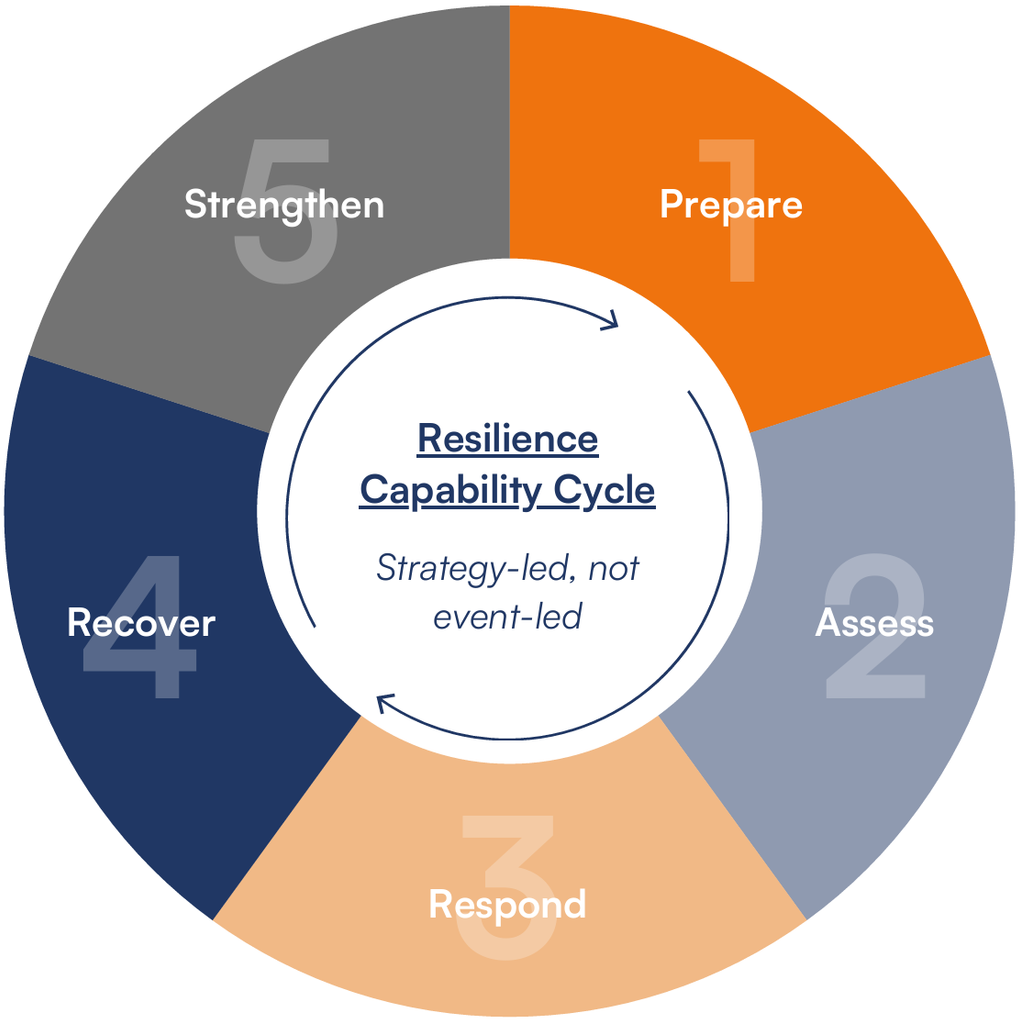
The diagram below reflects that resilience is not a one-time checklist activity but is a continuous capability that evolves as the organisation, its risks and its operating environment change.
History offers numerous examples of how decisive leadership can shape organisational outcomes during periods of disruption. In 1982, Johnson & Johnson responded to the Tylenol poisonings by recalling 31 million bottles nationwide and placing consumer safety ahead of short-term commercial considerations. The company subsequently introduced tamper-resistant packaging that helped establish a new industry standard, and the brand recovered virtually all of its market share within a year. The lesson remains relevant today: while organisations cannot always prevent crises, the quality, speed and clarity of the leadership response often determines how effectively trust, reputation and strategic momentum are preserved.
“Crises do not create culture, they reveal it.”
The imperative is straightforward. Plan for adversity. Build for agility. Pivot with intent. Resilience is not a side programme or a compliance exercise; it is a board-level capability that protects trust, preserves strategic momentum and determines whether an organisation can hold its shape under real pressure. Crises do not create culture, they reveal it. When the moment comes, leaders do not rise to a new standard. They fall back on the standards, disciplines and behaviours already embedded in the organisation.
Looking ahead, the most resilient organisations move beyond recovery and use resilience as a strategic capability to anticipate emerging risks, inform decision making and shape long-term success.
Resilient leadership is about continuously moving through a cycle of monitoring, assessing, deciding and acting.
Resilience Leadership in Practice
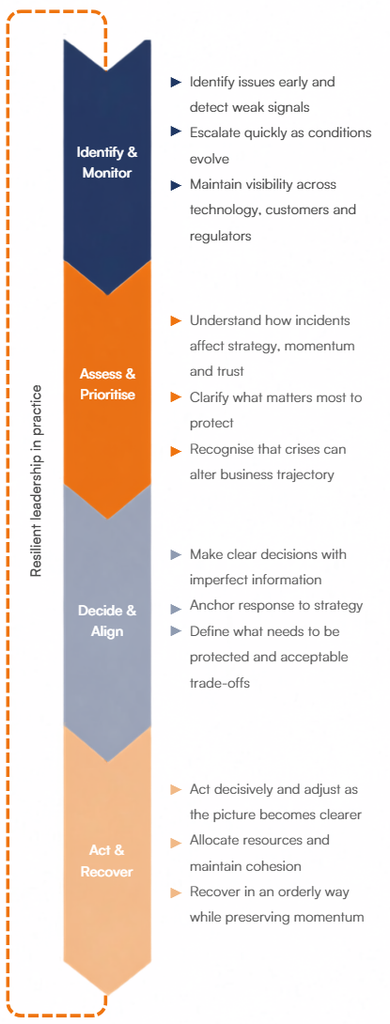
Identify & Monitor
- Identify issues early and detect weak signals
- Escalate quickly as conditions evolve
- Maintain visibility across technology, customers and regulators
Assess & Prioritise
- Understand how incidents affect strategy, momentum and trust
- Clarify what matters most to protect
- Recognise that crises can alter business trajectory
Decide & Align
- Make clear decisions with imperfect information
- Anchor response to strategy
- Define what needs to be protected and acceptable trade-offs
Act & Recover
- Act decisively and adjust as the picture becomes clearer
- Allocate resources and maintain cohesion
- Recover in an orderly way while preserving momentum
Why Resilience is a Strategic Capability
 Download the article